What is a PIR insulation board?
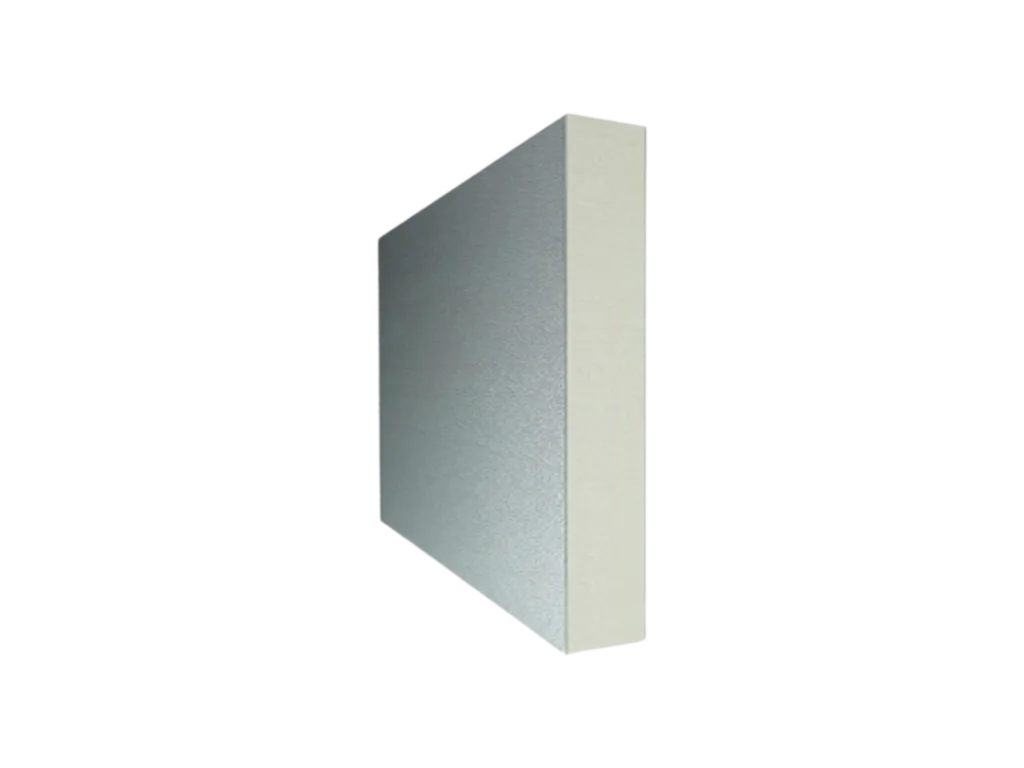
A PIR board is an insulation element with a facing layer laminated to both faces of polyisocyanurate foam, carrying no steel sheet. This is the basic difference from a sandwich panel: in a sandwich panel the core sits between two metal sheets and the panel acts as a load-bearing element; in a PIR board the facing is a thin surface layer and the board does not fall into the load-bearing class.
This difference directly determines where each is used. A sandwich panel is a building element, whereas a PIR board serves purely as an insulation material. The board works by being placed over, under or inside an existing building element.
Nuhpanel PIR boards are produced under the PIRBOARD range.
Why PIR?
The thermal conductivity of the PIR core is 0.022 W/mK. This value allows the same insulation performance to be reached in a noticeably thinner section compared with rock wool or EPS.
Where section thickness is limited, this becomes decisive. It creates an advantage in floors with restricted storey height, in duct and services voids, and in insulation applied to existing buildings at a later stage.
PIR also has a closed-cell structure; it shows higher resistance to water vapour than porous materials, and the risk of losing insulation value through moisture uptake is low.
The fire class is B-s1-d0. Test reports are published in the Library section.
Four facing options
What distinguishes the four PIRBOARD products from one another is not the core but the surface facing. The core is the same in all four; the facing determines where the board will be used.
PIRBOARD AL: Faced with aluminium foil. The foil acts as a vapour barrier and reduces heat transfer by radiation. It is chosen for air duct insulation, services voids and applications where vapour transmission is controlled.
PIRBOARD KR: Faced with kraft paper. It offers an economical facing option. It is used in enclosed, protected voids and in applications where the board is covered by another layer.
PIRBOARD GF: Faced with glass fleece. Its mineral-based surface allows mortar, screed or adhesive to be applied. It is preferred in roof and terrace insulation and on surfaces that will be covered over.
PIRBOARD ULTRA: The product in the range with upper surface performance.
Dimensions and thicknesses
All PIRBOARD products are produced in standard board dimensions:
| Width | Length | Thickness |
|---|---|---|
| 1200 mm | 2400 mm | 20-200 mm |
Thickness is selected according to the target insulation value and the section limit in the existing project. Keeping the board dimension fixed simplifies cutting and waste planning on site. The 1200 × 2400 mm dimension forms a module fully compatible with standard architectural grid and floor dimensions.
Areas of use
- Air duct insulation: particularly with PIRBOARD AL
- Roof and terrace insulation: with PIRBOARD GF in applications that will be covered over
- Insulation below and above floors: where section thickness is limited
- Internal wall insulation: in insulation work applied later to existing buildings
- Cold rooms and services voids: as a supplementary insulation layer
- Prefabricated and modular building components
Boards developed for air duct manufacture are grouped in a separate range; for duct manufacture directly, see the Air duct section.
Installation and storage
A PIR board is not a load-bearing element. In applications such as floors that will carry load, trafficable terraces or service walkways, the layer carrying the load is not the board but always the screed or slab above it.
Boards are stacked on flat, sound ground and protected from moisture. Kraft-faced products must be carefully protected from rain. A wetted paper surface loses both its bonding and its vapour barrier function.
Cutting is easily done with standard hand tools. Sealing joints and board junctions tightly is a more decisive step than the choice of thickness; a single open joint largely cancels out the gain provided by the insulation section.
PIR board prices
A PIR board has no fixed square metre price. The main items determining the price are:
- Thickness: the amount of material used varies considerably between 20 mm and 200 mm
- Surface facing: kraft facing is the most economical option, while glass fleece and aluminium foil create different costs
- Quantity: pallet and shipment planning is directly reflected in the price
Once the required square metres, the target insulation value and the application area where the board will be used are provided, the technical team determines the appropriate thickness and facing type, and the sales team responds within the day.
Frequently asked questions
What is the difference between PIR and PUR? PIR is the type of polyurethane chemistry with improved high-temperature behaviour. Their thermal conductivities are very close to each other; the real difference appears in behaviour under fire and in thermal stability. This resistance is the main reason PIR is preferred in insulation boards.
How do you choose between a PIR board and a rock wool board? If section thickness is limited, PIR is chosen; it provides the same insulation in a noticeably thinner section. If fire class A2 is mandatory, rock wool is required, because the class of the PIR board is B-s1-d0.
Which surface facing should be selected? If the board remains exposed or vapour control is required, aluminium foil (AL) is applied. If mortar, screed or adhesive will be applied over it, glass fleece (GF) is preferred. In enclosed, protected applications where the board is covered by another layer, kraft (KR) stands out as the most economical option.
Can you walk on a PIR board? The board has no load-bearing character. In every application that will carry load, the layer carrying the load is not the board but always the screed or slab above it. If it is necessary to walk on the board during site work, temporary load-spreading surfaces are used.
How are the boards cut? They are cut easily with standard hand tools; a saw or a sharp knife is sufficient. Producing a clean cut surface is of great importance for sealing the joint tightly.
How are joints sealed? They are sealed with aluminium tape or a suitable mastic. This step is far more decisive than the choice of thickness. A single joint left open largely eliminates the gain expected from the entire insulation section.
Does the board lose its insulation value over time? Thanks to its closed-cell structure the risk of moisture uptake is low, and when correctly applied it shows lasting performance. The real cause of insulation loss is not the material but incorrect site practice: a wetted kraft surface, joints left open and crushed board edges lead to this loss.