What is a cold room panel?
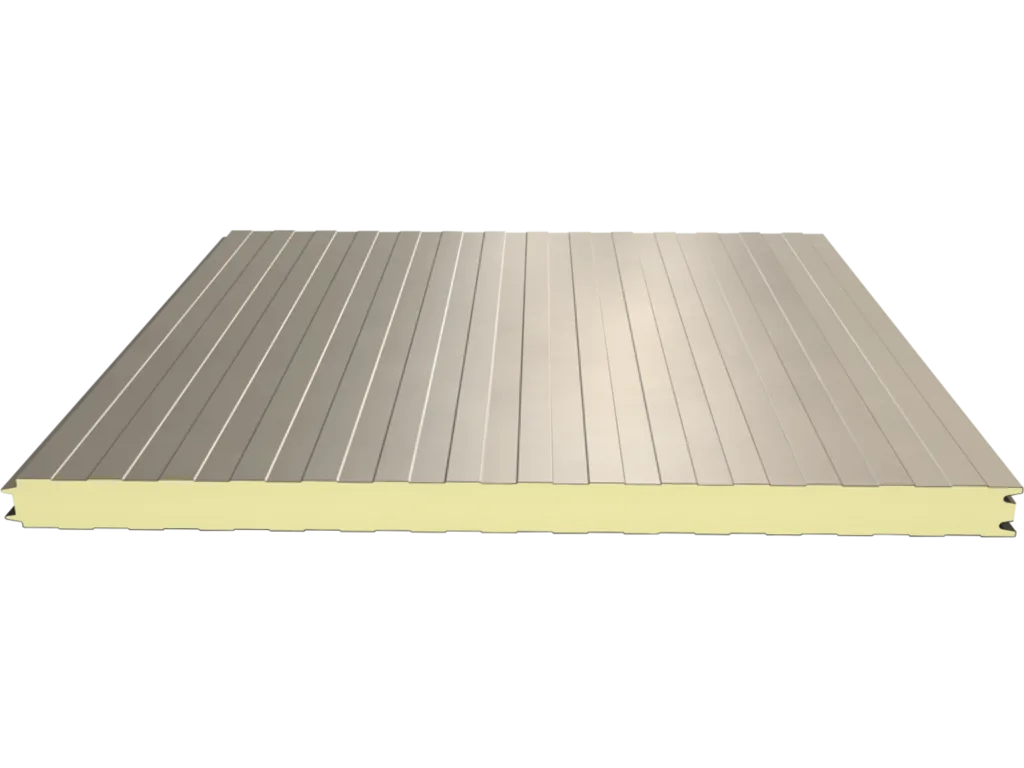
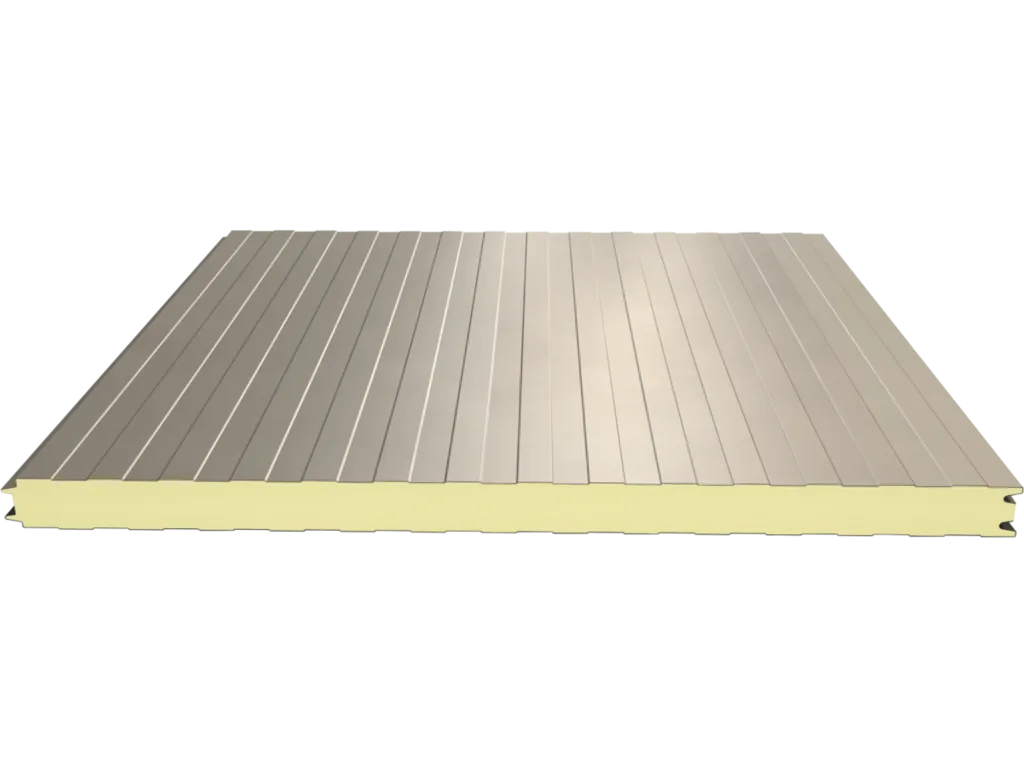
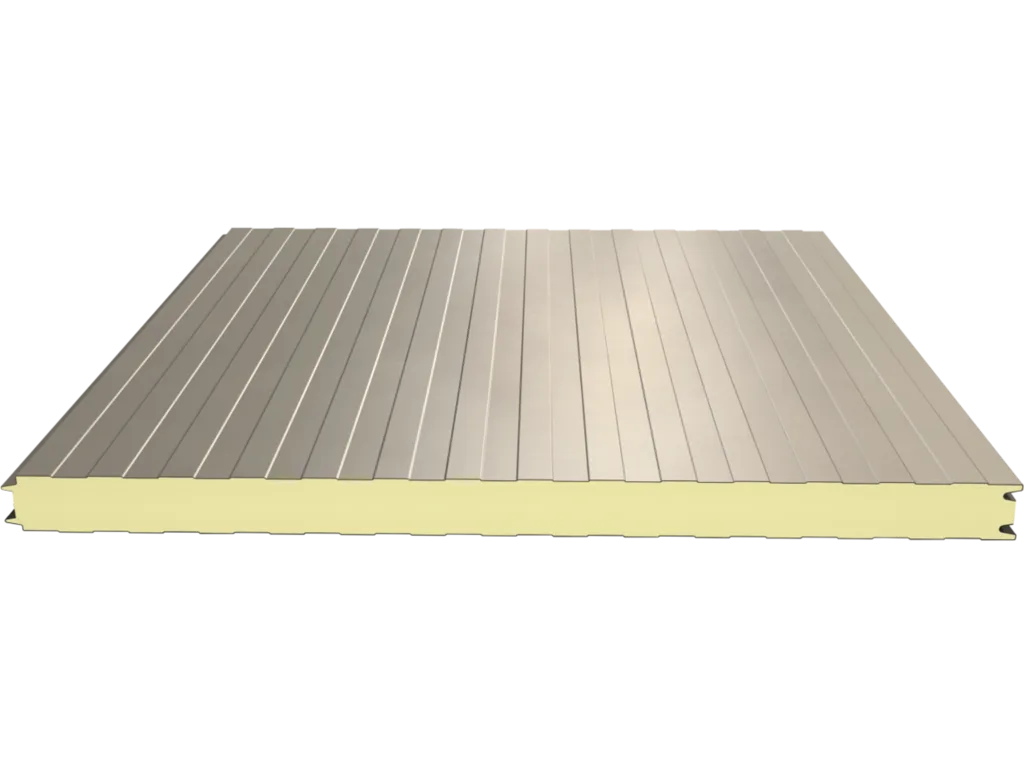
A cold room panel is a building element in which an insulation core is pressed between two metal sheets, with a locking joint detail. It forms the wall, ceiling and partition surfaces of cold storage facilities, blast freezing rooms, processing areas and cold chain plants.
What separates a cold room panel from a standard wall panel is not the thickness but the joint detail. A locking cam profile runs along the panel edges; panels interlock and thermal bridging at the joint is prevented. In cold applications a thermal bridge causes not only energy loss but also condensation and ice build-up, which creates a direct food safety problem.
Cold room panels are produced under the CCP01 series.
Why a PUR-PIR core?
All cold room panels are produced with a PUR-PIR core, and there is a technical reason for this.
With a thermal conductivity of 0.022 W/mK, PUR-PIR reaches the same insulation value at half the thickness of rock wool. In a cold room this brings two gains: the external dimension stays the same while more storage volume is left inside, and the lighter envelope reduces the load on the load-bearing structure.
The second reason is water vapour. In a cold room, moisture applies constant pressure from the warm side towards the cold side. A closed-cell polyurethane core offers far higher resistance to water vapour than porous materials, so the risk of the core taking up moisture over time and losing its insulation value is low.
The fire class is B-s1-d0. Test reports are published in the Library section.
Three panel types
CCP01 PU: The standard cold room panel. It has a micro-ribbed surface and a locking cam joint. It is used as the basic product for cold storage facility walls and ceilings.
CCP01 PU Anti-Bacterial (CCP01 AB): Carries an antibacterial coating on the inner face. It is produced for volumes with a high hygiene classification, such as processing areas in direct contact with food, meat and dairy plants and ready-meal production.
CCP01 PU PVC (CCP01 PVC): A flat-faced panel with a PVC-laminated inner face. The PVC layer provides resistance to washing and chemical cleaning; thanks to its non-porous surface it is cleaned by wiping. It is applied in production areas subject to intensive washing.
Dimensions and thicknesses
The cover width varies by product. The panel length is cut to the project dimension and produced in a single piece up to 15.5 metres.
| Product | Cover width | Thickness |
|---|---|---|
| CCP01 PU | 1000 / 1095 / 1200 mm | 60-200 mm |
| CCP01 PU Anti-Bacterial | 1000 / 1050 mm | 60-200 mm |
| CCP01 PU PVC | 1000 / 1050 mm | 40-200 mm |
The thickness is selected according to the operating temperature of the room. As general guidance, thinner sections are sufficient in storage rooms operating at +2 / +4 °C, while the upper thicknesses are used in frozen product stores and blast freezing rooms operating at −18 °C and below. The exact thickness is calculated according to room volume, ambient temperature, door traffic and cooling load, and this calculation is made together with the technical team.
Facing options are polyester, PVDF, plastisol and DPF.
Floor, doors and details
A cold room envelope does not consist of walls alone. Three details are as important as the panel selection:
- Floor insulation: Particularly in frozen product stores, the heat flow from beneath the floor and the risk of frost heave are taken into account.
- Doors and openings: The area around a door is the weakest point of the envelope. The panel thickness and the door frame detail must work in harmony with each other.
- Vapour barrier continuity: Proper closing of the cam joint and correct sealing of joints and corners play a more decisive role than the insulation thickness.
Joint details are shown as drawings in the Library section.
Installation and storage
Panels are stacked on a flat, solid base and protected from moisture. No more than two bales are placed on top of each other. Cam profiles are sensitive to impact; edge protection is always applied during stacking and handling. A crushed cam prevents the panel from closing fully and leads to ice build-up at the joint.
The protective film is removed from the surface immediately after installation is completed.
Areas of use
- Cold storage facilities and frozen product stores
- Blast freezing and pre-cooling rooms
- Food processing and packaging plants
- Meat, dairy, seafood and ready-meal production
- Fruit and vegetable market and storage facilities
- Pharmaceutical and vaccine stores, temperature-controlled volumes
- Chilled areas in logistics centres
Cold chain facility solutions are covered in the Solutions section.
Cold room panel prices
There is no fixed square metre price for a cold room panel. The items that determine the price are:
- Thickness: The amount of material used between 60 mm and 200 mm varies considerably.
- Inner face: Antibacterial coating and PVC lamination differ from standard steel sheet.
- Cover width: A 1200 mm panel provides fewer joints and faster installation over the same area.
- Quantity and panel length: Waste ratio and production planning are reflected directly in the price.
Once the room dimensions, target operating temperature and region are provided, the technical team determines the suitable thickness and panel type, and the sales team responds the same day.
Frequently asked questions
How many mm should a cold room panel be? The main factor is the operating temperature of the room. Thinner sections are sufficient in storage rooms (+2 / +4 °C), while the upper thicknesses are used in frozen product stores and blast freezing rooms (−18 °C and below). The exact thickness is calculated according to room volume, ambient temperature, door traffic and cooling load.
Why is there no rock wool cold room panel? The determining factors in a cold room are the insulation value and water vapour resistance. Rock wool gives the same insulation at roughly twice the thickness and, because of its porous structure, carries a risk of moisture uptake. These two reasons make the use of a closed-cell PUR-PIR core mandatory in a cold room envelope.
When is an antibacterial panel required? It is used in meat, dairy, seafood, ready-meal and packaging areas where the product is in direct or indirect contact with the panel. In a storage room that holds only closed-packaged products, standard CCP01 PU is preferred.
What is the difference with a PVC-laminated panel? Because its inner face is non-porous and flat, it can be washed with pressurised water and chemicals. In production areas washed daily it provides a clear advantage over a steel sheet surface.
Why does ice form at the joints? Ice build-up almost always stems from an envelope fault rather than the panel: the cam does not close fully, a joint leaks, or the door frame detail creates a thermal bridge. Moisture passes from the warm side to the cold side and condenses and freezes on the first cold surface. For this reason installation quality plays a more decisive role than the thickness selection.
Is the floor also made with panels? A cold room floor is usually resolved not with panels but with an insulation and screed layer designed to carry the load above it. Particularly in frozen product stores, the heat flow from beneath the floor and the risk of frost heave are calculated separately.
Can the room be enlarged later? The cam-jointed panel system can be dismantled and rebuilt, so extension is possible. However, the cam profiles of the dismantled panels must be undamaged; when a panel with a crushed cam is reused, the joint does not close fully.