What is an acoustic panel?
An acoustic sandwich panel is a roof or wall panel whose inner steel sheet is perforated. The perforated sheet lets the sound wave reach the insulation core inside the panel, and the core absorbs the sound energy. A standard panel reflects sound; an acoustic panel absorbs it.
This distinction matters, because noise control involves two separate problems. Sound insulation concerns stopping sound from passing from one space to another, and is largely a matter of mass. Sound absorption concerns reducing the reverberation of sound within the same space, and is a matter of surface. The acoustic panel solves the second one: it stops noise generated inside from bouncing back off the walls and ceiling and building up.
Acoustic panels are produced with a perforated inner sheet, in the same profile and thickness range as standard roof and wall panels.
Four products
| Product | Code | Position | Core | Fire class |
|---|---|---|---|---|
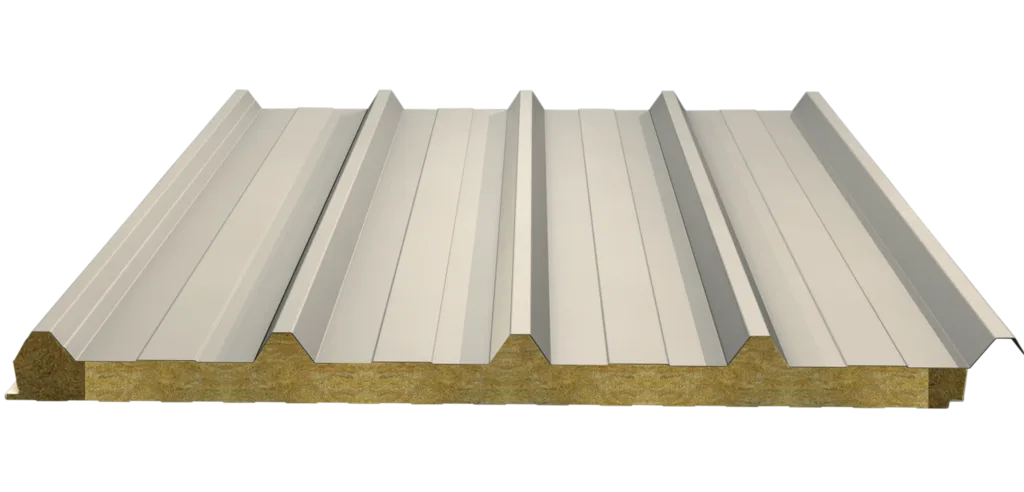
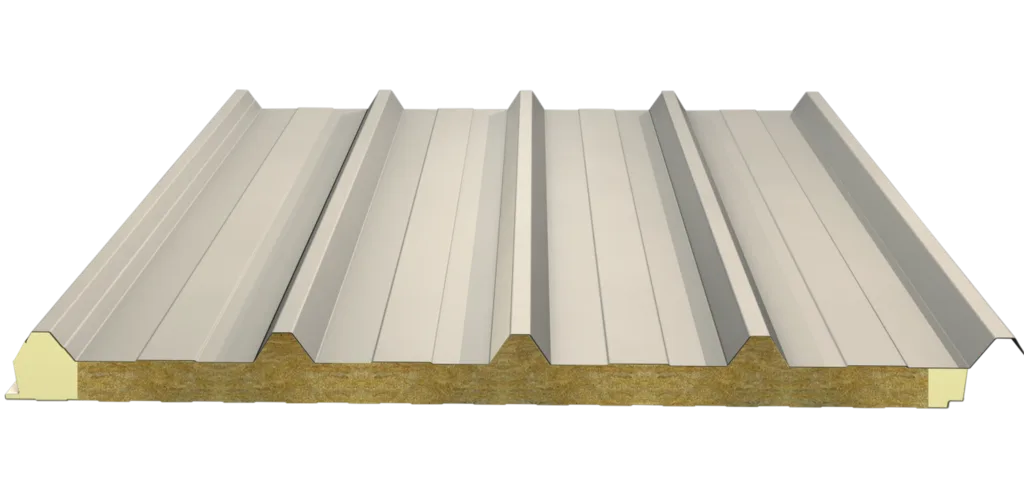
| Acoustic Roof - Hybrid | NRP5STS-A H | Roof, 5-rib | Hybrid | A2-s1-d0 |
| Acoustic Roof - MW | NRP5STS-A RW | Roof, 5-rib | Rock wool | A2-s1-d0 |
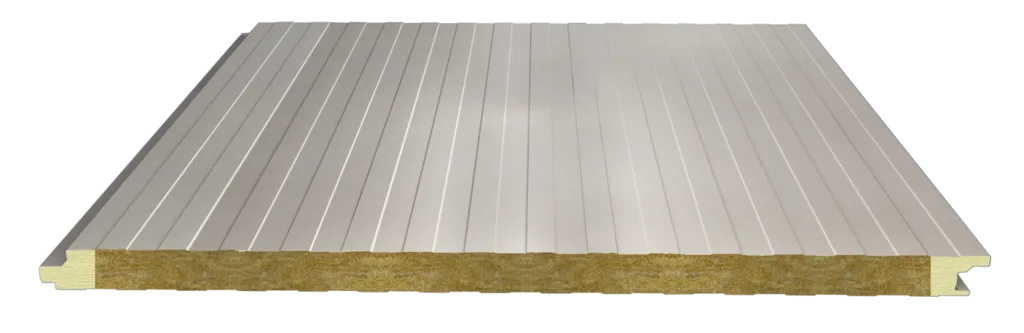
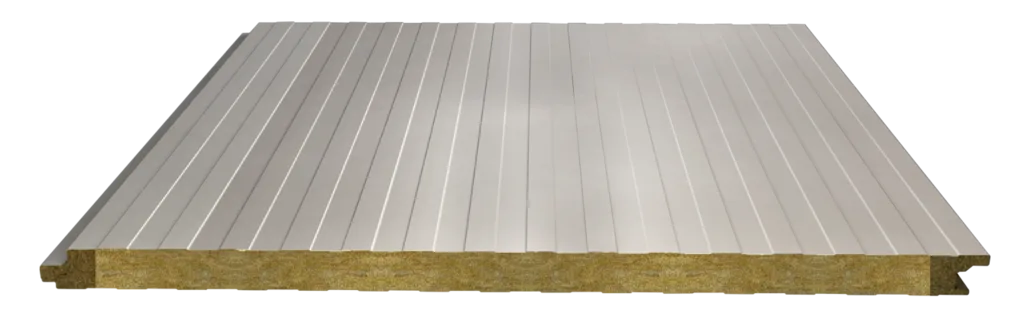
| Acoustic Wall - Hybrid | NWP0STS-A H | Wall, micro rib | Hybrid | A2-s1-d0 |
| Acoustic Wall - MW | NWP0STS-A RW | Wall, micro rib | Rock wool | A2-s1-d0 |
All four products have a thermal conductivity of 0.045 W/mK, a thickness range of 40-200 mm and a cover width of 1000 mm. Panel length is produced in a single piece up to 15.5 metres.
Why rock wool and hybrid?
In an acoustic panel, the choice of core rests on a different reason than in standard panels. For sound absorption the core must be porous: the sound wave is expected to lose energy through friction within the fibre structure of the material.
Rock wool behaves exactly this way. Its fibrous, open-pore structure forms an effective absorbing layer behind the perforated sheet. Closed-cell polyurethane, on the other hand, does not admit the sound wave; for this reason the acoustic range includes no product with a pure polyurethane core.
In the hybrid option the body is rock wool, with a polyurethane strip only along the joint edges. The foam strip holds the screw seat tight; it is not used for insulation. Since almost the entire section is rock wool, the fire class class is also that of rock wool, A2-s1-d0. There is no separate classification report for the hybrid panel.
Where is it used?
Acoustic panels are used in any building where noise causes discomfort inside or spills outside:
- Production facilities: Reduces the internal noise level in press, compressor, weaving and machining areas.
- Facilities near residential areas: Preferred in factories where noise spilling into the surroundings must stay within regulatory limits.
- Sports halls and indoor courts: Reduces the reverberation time that makes speech unintelligible in spaces with high ceilings and hard surfaces.
- Power plants and machine rooms: Used in the insulation of steady, high-level noise sources.
- Conference, education and social facility buildings
- Car parks and service buildings
Panel selection and acoustic calculation
An acoustic panel is not a solution on its own but part of one. What determines the reverberation time in a space is the total area and distribution of the absorbing surface; making only the ceiling acoustic is sometimes enough and sometimes not.
The correct process follows this order:
- The target noise level or reverberation time is set.
- The dimensions, surface areas and existing absorption of the space are determined.
- The amount of acoustic surface required is calculated.
- A decision is made on whether that surface goes on the roof or the wall, and in what proportion.
The sound absorption values of the products are based entirely on measurement. For project-specific calculations, support is available from the technical team; test documents and technical documentation are published in the Library section.
Installation and storage
A perforated sheet is more delicate than a flat sheet. The edges of the perforations are easily crushed by impact, and a crushed surface spoils both appearance and absorption. Panels are stacked on flat, solid ground, protected from moisture, and no more than two bales are placed on top of each other.
Acoustic panels with a rock wool core must never be exposed to rain while waiting. Wet rock wool loses both its insulation and its sound absorption value; in addition, the perforated sheet lets water reach the core far more easily. For this reason panels are always kept covered.
All joint details are given in the Library section.
Acoustic panel prices
An acoustic panel has a more costly structure than a standard panel of the same thickness. The perforated sheet requires a separate production step, and core options are limited.
The main items that determine the price are:
- Core type: Rock wool or hybrid options.
- Thickness: The amount of material, varying between 40 mm and 200 mm.
- Position: Roof profiles and wall profiles are priced differently.
- Facing and colour: PVDF, plastisol and special RAL colours are separate from standard polyester.
- Quantity and panel length.
Once the dimensions of the space, the noise source and the target are provided, the technical team calculates how much acoustic surface is required and the sales team responds the same day.
Frequently asked questions
Does an acoustic panel block sound or absorb it? It absorbs. An acoustic panel reduces reverberation and noise build-up within the same space. Stopping sound from passing from one space to another is a separate problem and is largely solved with mass; at that point panel thickness and sheet weight come into play.
Does the whole roof have to be acoustic panel? Most of the time it does not. What is decisive is the total area of absorbing surface; depending on the size of the space and the target reverberation time, a part of the roof may be enough. This process proceeds with acoustic calculation, not estimation.
Why is there no acoustic panel with a polyurethane core? For sound absorption the core must be porous; the sound wave is expected to lose energy through friction within the fibre structure. Closed-cell polyurethane does not admit the sound wave, which is why the acoustic range uses rock wool and hybrid cores.
Hybrid or rock wool? Both have a fire class of A2-s1-d0, because the core of the hybrid panel is also rock wool. The difference comes from the polyurethane strip along the joint edges: this strip holds the screw seat tight and makes the panel somewhat lighter. There is no separate classification report for the hybrid.
Does the perforated sheet get dirty, and can it be cleaned? A perforated surface collects more dust than a flat one. In dusty production environments, periodic cleaning with compressed air is applied. Pressurised water is not preferred, as it carries the risk of driving water into the core.
Does an acoustic panel reduce noise spilling outside? Indirectly, yes. Since the sound level building up inside through reverberation drops, the energy reaching the wall also drops. However, the decisive factor for noise spilling into the surroundings is the sound tightness of the envelope; the two subjects are always assessed together.
Can it be added to an existing building later? Acoustic panels can be applied to the inner face of an existing roof or wall. In this case, whether the existing structure can carry the additional load and the new layer sequence formed with the existing insulation are checked beforehand.