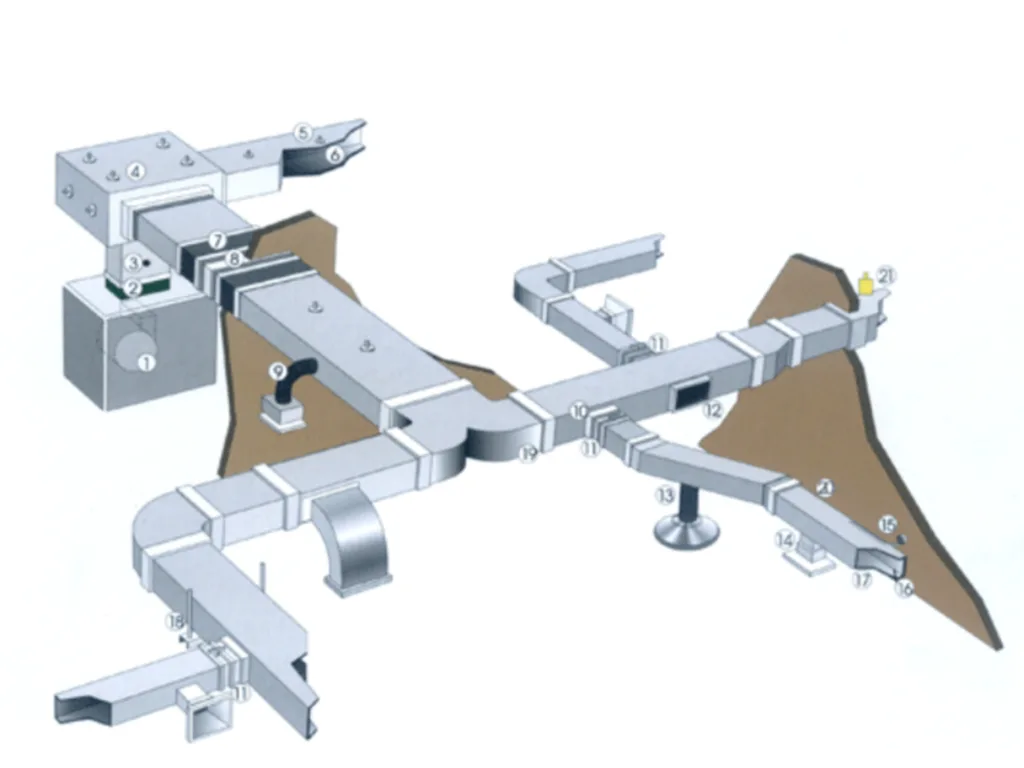
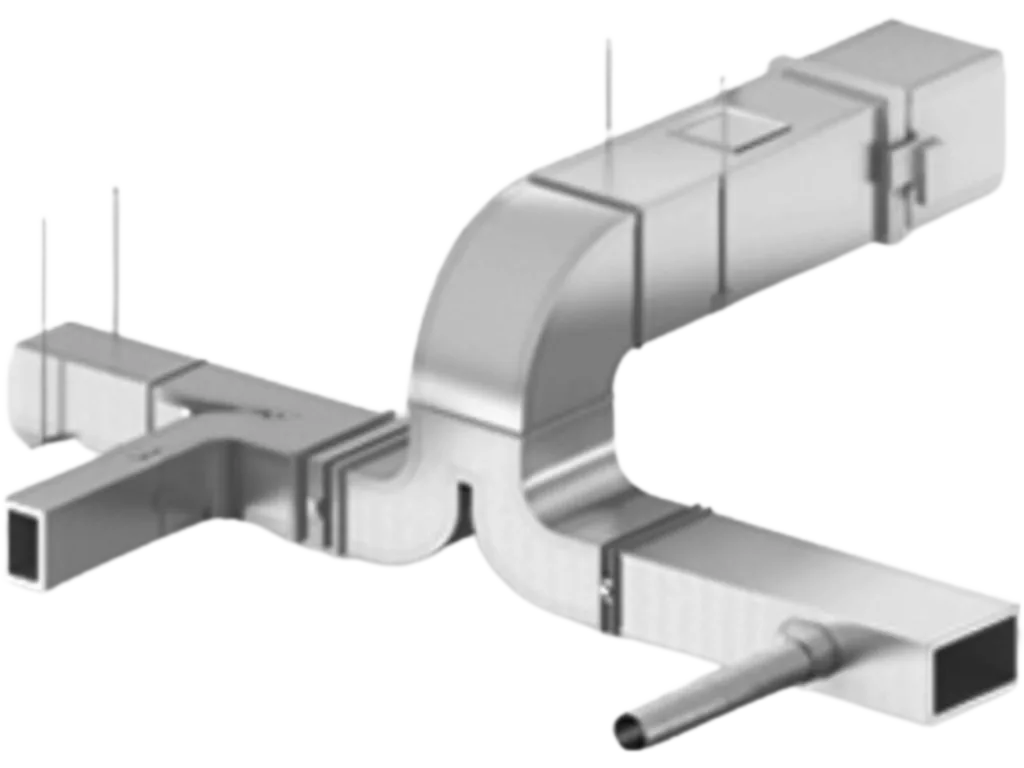
What is a ventilation duct board?
A ventilation duct board is a construction material with aluminium laminated to both faces of a PIR foam core, from which the duct itself is fabricated. In the conventional system the duct is made of galvanised steel sheet and then insulated from the outside; in this system the duct is formed directly from the insulated board.
The difference is not limited to the sequence. In a steel duct the insulation sits on the outside and over time it can separate, be crushed, or open up at the joints. In a duct fabricated from board the insulation forms the body of the duct; since there is no separate layer, there is nothing left to separate.
The second difference is weight. An aluminium-PIR duct weighs far less than a steel duct of the same section. This means less material in the support system, less labour during installation and easier routing within the suspended ceiling void.
Nuhpanel ventilation duct boards are produced under the NKS series.
NKS series products
| Product | Thickness | Facing |
|---|---|---|
| NKS 20 80/80 | 20 mm | Stucco embossed, aluminium on both faces |
| NKS 30 80/80 | 20-30 mm | Stucco embossed, aluminium on both faces |
| NKS 30 80/200 | 20-40 mm | Stucco embossed, for external environments |
All three boards have a thermal conductivity of 0.022 W/mK, a fire class class of B-s1-d0 and a board size of 1200 × 2400 mm.
The figures 80/80 and 80/200 state the aluminium thickness on the two faces of the board. In 80/80 boards both faces are identical and they are used for indoor ducts. In the NKS 30 80/200 model the aluminium on the outer face is significantly thicker; this board is produced for ducts running into external environments and for rooftop lines. On surfaces exposed to UV, precipitation and mechanical impact, a thin foil does not provide adequate protection.
The facing has a stucco embossed texture. This texture increases the rigidity of the aluminium and scatters light reflection on the duct surface, producing an even appearance.
Why a PIR core?
Insulation in a ventilation duct has two basic functions: maintaining the temperature of the conveyed air and preventing condensation on the duct surface.
The 0.022 W/mK thermal conductivity of the PIR core provides high insulation in a thin section. Duct dimensions are limited by the suspended ceiling void; every centimetre gained from the section translates directly into air flow rate or usable ceiling height.
The closed cell structure solves the condensation problem. If the outer surface of a duct carrying chilled air falls below the dew point in a warm, humid environment, water collects on the surface. A closed cell core does not take water into its structure; the aluminium facing also acts directly as a vapour barrier in the system.
The duct fabrication process
Fabricating a duct from NKS board follows a different method from steel sheet duct. The board is grooved at an angle with special knives and folded to form the duct section. The corners are closed with adhesive and aluminium tape; flange profiles join the connection points.
This practical method allows fabrication directly on site. The duct is cut and folded in place according to the section in the project; waiting time for prefabricated parts and the risk of dimensional error are largely reduced.
Support spacing is determined by the duct section and the board thickness. Internal support profiles are used on wide sections. Consult the technical team for installation details; all related documents are available in the Library section.
Applications
- Ventilation installations in commercial buildings and offices
- Air conditioning lines in shopping centres, hotels and hospitals
- Fresh air and exhaust ducts in industrial facilities
- Hygienic duct lines in clean rooms and food production facilities
- Lines carrying chilled air and routes with a risk of condensation
- Rooftop ducts running into external environments (NKS 30 80/200)
Storage and handling rules
Stack the boards flat on level ground. The aluminium facing is sensitive to impact; a crushed surface spoils both the appearance and the straightness of the fold line. For this reason boards must never be left standing upright or leaning against a support.
Protect the material against moisture. Before grooving and folding, make sure the board has reached ambient temperature. In a cold board the insulation foam behaves in a brittle way and unwanted cracks form along the fold line during the operation.
Ventilation duct board prices
NKS board has no fixed square metre price. The main items that determine the price are:
- Thickness: the amount of material used varies between 20 mm and 40 mm
- Aluminium thickness: the 80/200 external board differs from the 80/80 indoor board
- Lacquer coating: the optional surface coating is priced separately
- Quantity: pallet and shipment planning is reflected directly in the price
Once you provide the duct quantities, the sections and whether the line runs indoors or outdoors, the technical team determines the suitable board type and thickness, and the sales team responds the same day.
Frequently asked questions
Why a board duct instead of a steel sheet duct? Three reasons stand out. Because the insulation is the body of the duct rather than a separate layer, it does not separate over time. The duct is much lighter and considerably relieves the support system. Since fabrication takes place directly on site, dimensional error and waiting time are reduced.
What is the difference between 80/80 and 80/200? The figures state the aluminium thickness on the two faces. The 80/80 series is used for indoor lines. In the 80/200 series the aluminium on the outer face is significantly thicker; this board is chosen for lines running into external environments and along rooftops.
How many mm should the duct board be? Indoors and on short lines, 20 mm thickness is often sufficient. On long lines carrying chilled air, on routes passing through warm and humid spaces and outdoors, the 30-40 mm range is used. The determining factor here is the risk of condensation.
Why does condensation occur on the duct surface? If the outer surface of a duct carrying chilled air falls below the dew point of the environment, water collects. The basic solution is to increase the thickness and to maintain continuity of the vapour barrier. The aluminium facing acts as the vapour barrier in the system, and properly taping the joints completes this continuity.
Are special tools required for duct fabrication? A grooving knife and flange profiles are essential; apart from these, fabrication is completed with standard hand tools. Support for installation details is available from the technical team.
What should the support spacing be? It is confirmed according to the duct section and the board thickness. Internal support profiles are used on wide sections. Because the duct is light, the support system carries less load than with a steel duct, but the spacings are not chosen arbitrarily.
Can the board be cut while cold? It can be cut, but it must never be folded. In a cold board the foam behaves in a brittle way and cracks form along the fold line; for this reason the board is grooved only after it has fully reached ambient temperature.