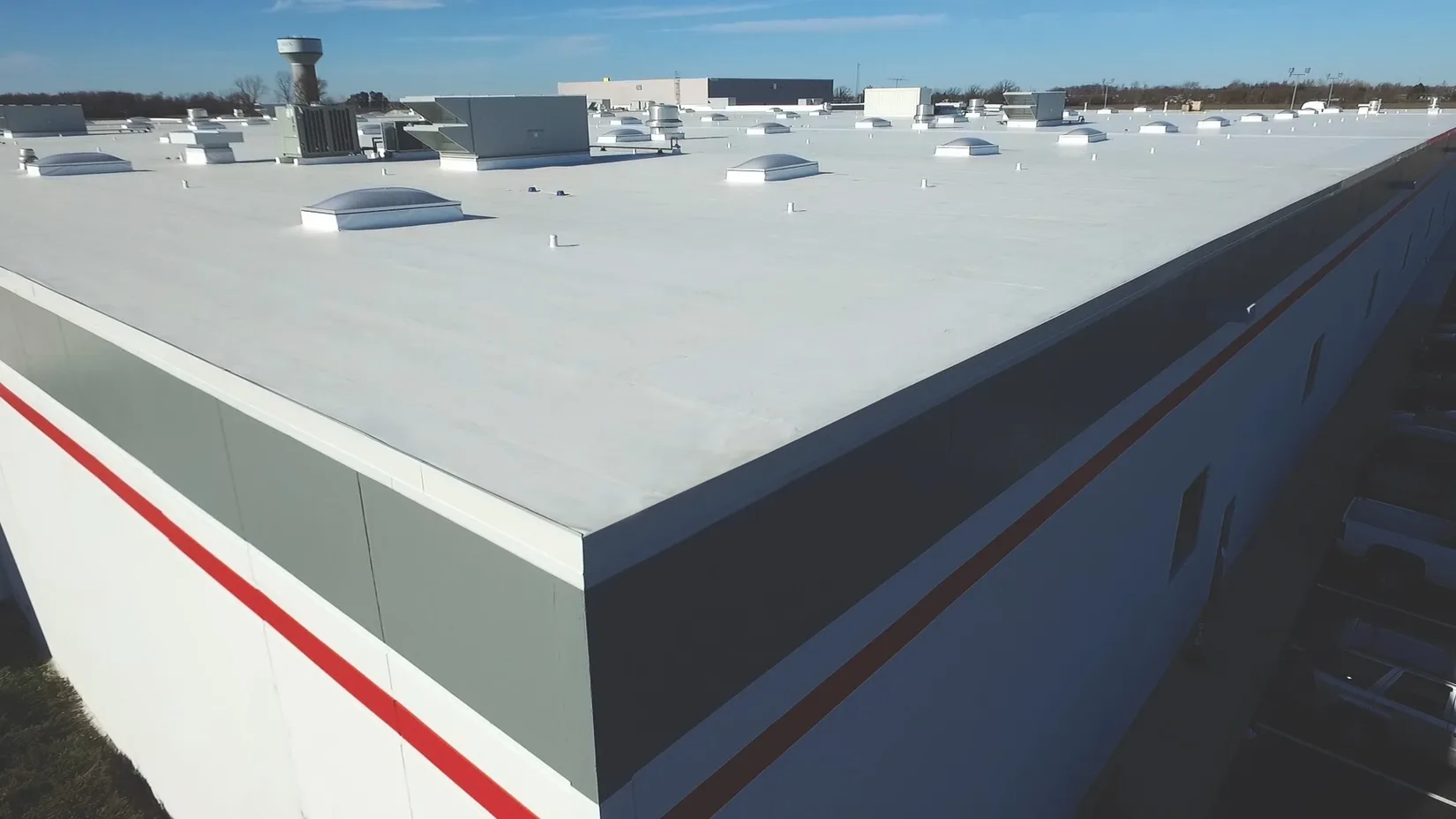
On low-pitch roofs the problem is not insulation but water. As the pitch falls, water stays longer on the surface and the weak point of the envelope moves to the joints. The TRIPAN roof panel addresses that point: it is a roof panel with a PVC laminated outer sheet.
Technical data
| Property | Value |
|---|---|
| Product code | NRP5-SSM |
| Profile | 5 ribs, rib height 37 mm |
| Insulation thickness | 40-200 mm |
| Panel length | Up to 15.5 metres in one piece |
| Core | PUR-PIR, rock wool or hybrid |
| Facing | PVC laminated steel; polyester, PVDF and plastisol coating options |
The thermal conductivity varies with the core: 0.022 W/mK with a PUR-PIR core and 0.045 W/mK with a rock wool or hybrid core.
What does the PVC laminated sheet do?
In conventional membrane roof solutions the membrane and the steel are two separate layers, and the steel, expanding with temperature, works against the membrane above it. In TRIPAN the membrane is laminated to the steel itself; the surface behaves as a single layer and does not deform under the panel.
On roofs with heavy organic fouling such as bird droppings, leaves and resin, the laminated surface removes the point where wear begins.
It removes the need for a concealed gutter
This is the most concrete economic benefit in practice: TRIPAN removes the need for a separate gutter on the roof. A concealed gutter is both a construction item and a discontinuity requiring maintenance; when it is dropped, both go.
The core decides the fire class
| Core | Fire class |
|---|---|
| Rock wool, hybrid | A2-s1-d0 |
| PIR | B-s1-d0 |
| PUR | B-s2-d0 |
Where the regulation requires class A2, the core is rock wool or hybrid and the insulation target is met with thickness. The reports are in the Library section.
The pitch rule does not change
Although TRIPAN is designed for low-pitch roofs, the minimum pitch for a sandwich roof panel is 7%. That rule is independent of the profile and the facing; below it the joint detail changes and the roof is planned again.
The joint details are drawn in the Library section.
Where is it preferred?
- Low-pitch industrial roofs
- Roofs with maintenance traffic that are walked on
- Buildings with a solar plant planned on the roof
- Regions with heavy organic and acidic fouling
The product pages are in the roof panels section. Use the U-value calculator for the thickness decision and the heat loss calculator for its annual value.