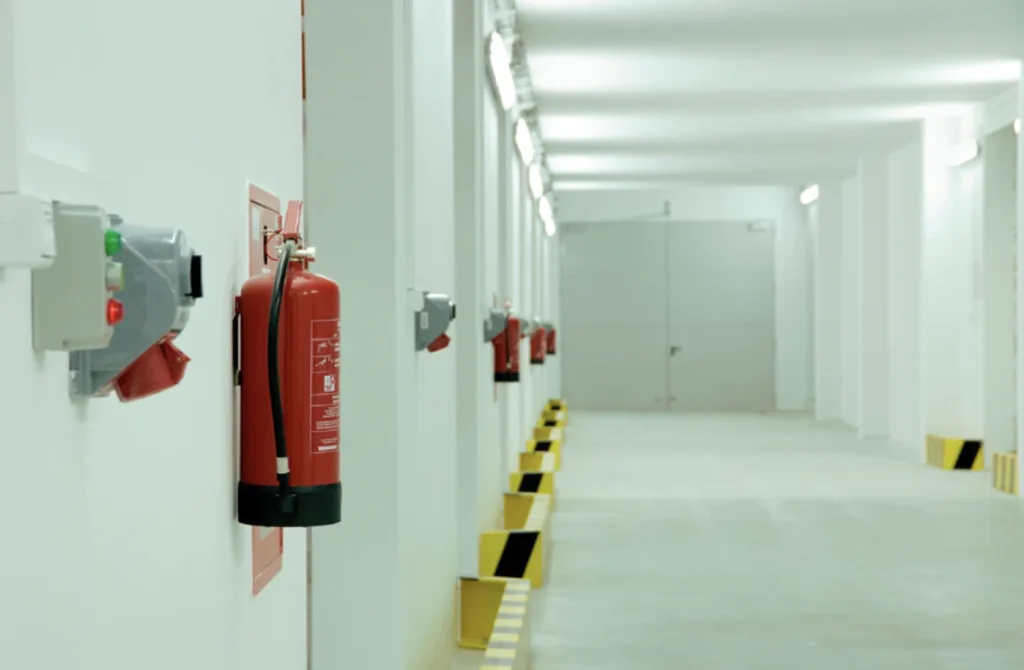
The behaviour of a panel in fire is measured by two separate questions, and the two are often used in place of each other. Where a specification asks for one and the other is certified, the project stops at the permit stage.
Two questions, two standards
Fire class (EN 13501-1) describes the reaction of the material to fire: ignition behaviour, smoke production and flaming droplets. It is a string of letters such as A2-s1-d0 or B-s1-d0.
Fire resistance (EN 13501-2) is the resistance of a building element in minutes: RE 30, REI 60 and so on. What is measured here is not the material but how long a wall or a roof keeps its function under fire.
A panel being class A2-s1-d0 does not mean it will last 60 minutes. Resistance time is given by a separate test report.
The class comes from the core
| Core | EN 13501-1 class |
|---|---|
| Rock wool | A2-s1-d0 |
| Hybrid | A2-s1-d0 |
| PIR | B-s1-d0 |
| PUR | B-s2-d0 |
| EPS | no published class |
The letters read as follows: the first shows burning behaviour, s shows smoke
production and d flaming droplets. s1 is the lowest smoke and d0 means no
flaming droplets.
The same panel is B-s2-d0 with a PUR core and B-s1-d0 with a PIR core. That is why, on a quotation that says "PUR-PIR", you ask which core will arrive; the class means something only together with the core.
Why does a hybrid core stay A2?
In a hybrid panel the core is rock wool based; the polyurethane is only at the edges, as a strip that holds the screw seat tight. Because the core itself remains mineral, the class is the same as rock wool: A2-s1-d0.
When the insulation target and the fire target collide
Where A2 is mandatory, the core is rock wool or hybrid and the thermal conductivity rises to 0.045 W/mK. The way to reach the same insulation value is not to change the core but to increase the thickness. The result for the section is read from the U-value calculator.
This is the trade-off design meets most often: the fire class comes from the regulation and is not negotiable; the insulation target is met with thickness.
What decides it on the building side
As much as the class of the panel, how the envelope is built affects the behaviour in fire:
- The compatibility of the panel and the joint where fire compartments meet
- Closing service penetrations with fire stopping
- Applying the joint details as drawn
- Points of discontinuity on the roof such as valleys, ridges and parapets
The details are drawn in the Library section.
No class is written without a document
On this site the fire class field is empty for products with an EPS core, because no EN 13501 class has been published for them. On a project where fire performance is decisive, an EPS cored panel is not considered; the standard range with a rock wool or PUR-PIR core is used instead.
Nuhpanel's test reports and classification documents are open in the Library section.
Three lines for the specification
- The fire class required and the standard it refers to (EN 13501-1)
- If resistance is required, the period and the class (EN 13501-2)
- Which core and which thickness the class is certified for
With those three lines written, there is no argument on site; without them the decision is made on site, and the decision on site is whatever is to hand.